From Compliance to Capability: Five E-learning Principles for Task-Ready Performance

Every organisation wants training that changes behaviour. Yet many employees still treat mandatory e-learning as something to complete as quickly as possible.

The problem is that completing an e-learning course doesn’t necessarily mean learning has taken place. Most people can click through screens, select the obvious answers and pass a multiple-choice assessment. But when they’re faced with a difficult customer, a safety incident or a compliance dilemma, will they know what to do?

At Sliced Bread, we believe the purpose of learning isn’t simply to transfer knowledge. It’s to prepare people to perform when it matters most.
That’s the difference between compliance and capability.

So how do we design e-learning that people actually remember and apply?

1. Start your E-learning with a Real Problem

Many training programmes begin by asking, “What does the learner need to know?”
A better question is, “What does the learner need to be able to do?”

When learners solve realistic problems, knowledge becomes a tool rather than the objective.
Take one of our VR culinary training experiences. Learners prepare Hollandaise sauce just as they would in a professional kitchen. If they whisk at the wrong speed, the sauce splits and they have to start again. Just like in real life.

Cooking Sim VR -Screengrab from the VR Cooking training of pouring water in to Hollandaise sauce while whisking

2. Give E-Learners a Mission

People naturally engage with stories because stories create purpose. Humans naturally make sense of the world through stories.
Every memorable story has a challenge, a conflict, or a threat that must be overcome. The same principle applies to learning.

Every effective e-learning experience should answer four questions:

  • What problem am I solving?
  • Why does it matter?
  • What’s at stake?
  • What does success look like?

We applied this principle in an immersive water safety experience about cold water shock.

Rather than reading about the body’s response, learners experience a simulated emergency. They witness their heart rate increase, hear their breathing become rapid and understand how panic can lead to inhaling water.

They then discover something equally important: within around a minute, the body begins to adapt. The lesson isn’t to panic, but to control breathing, stay afloat and make better decisions.
That’s far more memorable than reading a list of safety guidelines.

A leadership programme becomes more memorable when learners must navigate a difficult employee conversation and experience the consequences of their decisions. When e-learners feel ownership of the outcome, motivation shifts dramatically. They’re no longer completing a module. They’re on a mission.

3. Keep E-Learners in the Challenge Zone

Learning is most engaging when the challenge matches the learner’s ability. If it’s too easy, people lose interest. If it’s too difficult, they give up.
The best e-learning experiences gradually increase in complexity, building confidence with each success. Learners leave feeling capable, not overwhelmed.

Consider a customer service simulation. Early scenarios might involve straightforward complaints with obvious solutions. As learners become more confident, situations become increasingly complex, involving conflicting priorities, emotional customers or incomplete information.
Each challenge builds on the last.

Every success reinforces confidence and encourages learners to tackle more demanding situations.
E-learning becomes a journey of growing competence rather than a series of information screens.

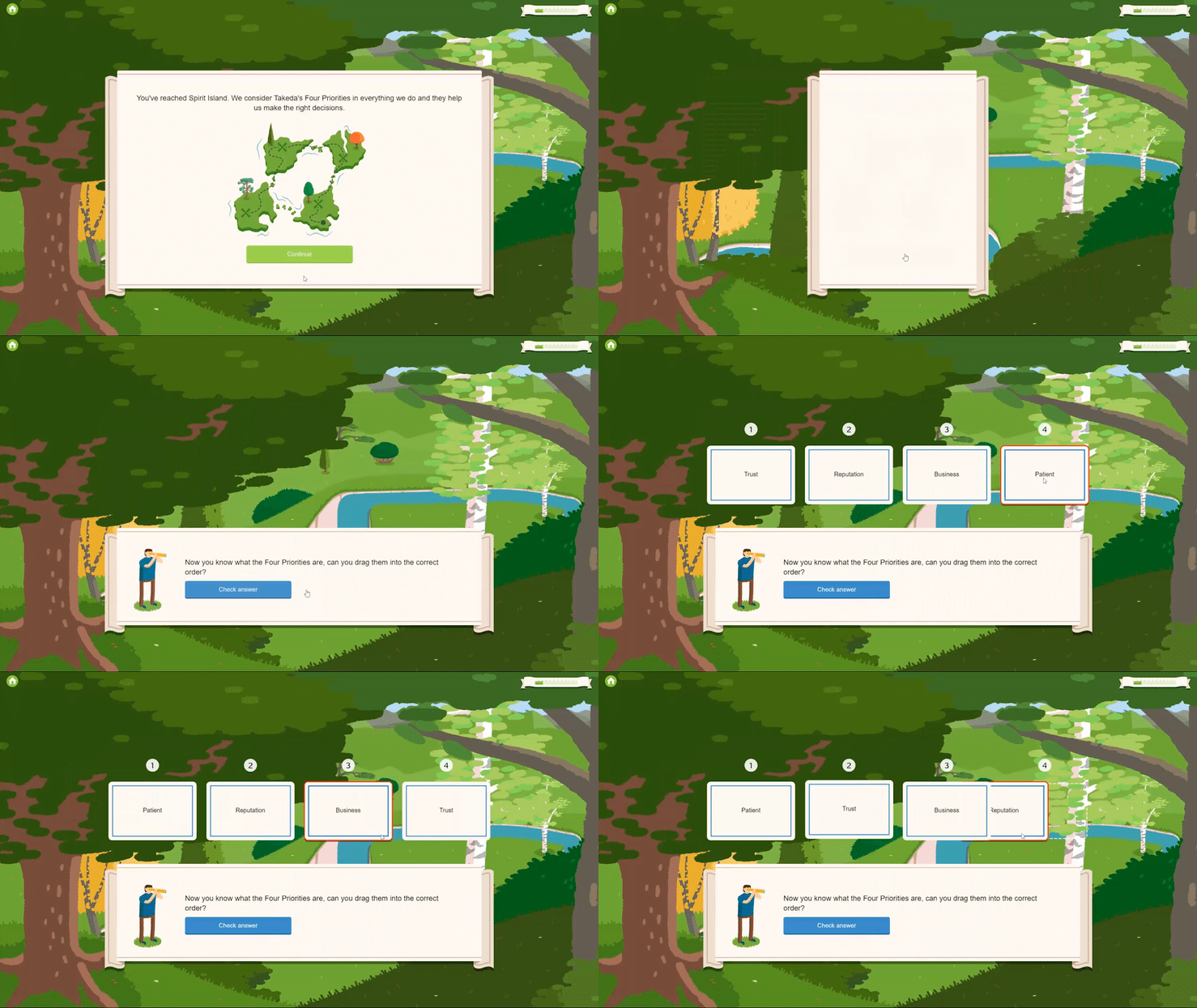
A gif of a map collapsing down then a question appearing and asking the user to order the 4 options

4. Reinforce E-Learning Through Action

E-learning shouldn’t stop when the course ends. Real behaviour change happens when knowledge is revisited, discussed and applied in everyday work. That’s why reinforcement is just as important as the initial learning experience.

Effective reinforcement might include:

  • Sharing key insights with colleagues
  • Reflection prompts
  • Coaching conversations with managers
  • AI-powered role-play with virtual avatars
  • Spaced refresher activities
  • Real-world micro-challenges that encourage immediate application
Imagine someone completing a conflict-management course. Rather than simply receiving a completion certificate, they’re challenged to use one active listening technique during their very next meeting and reflect on the outcome afterwards.
That small act of application helps transfer learning from short-term memory into long-term behaviour. Knowledge grows stronger through use.
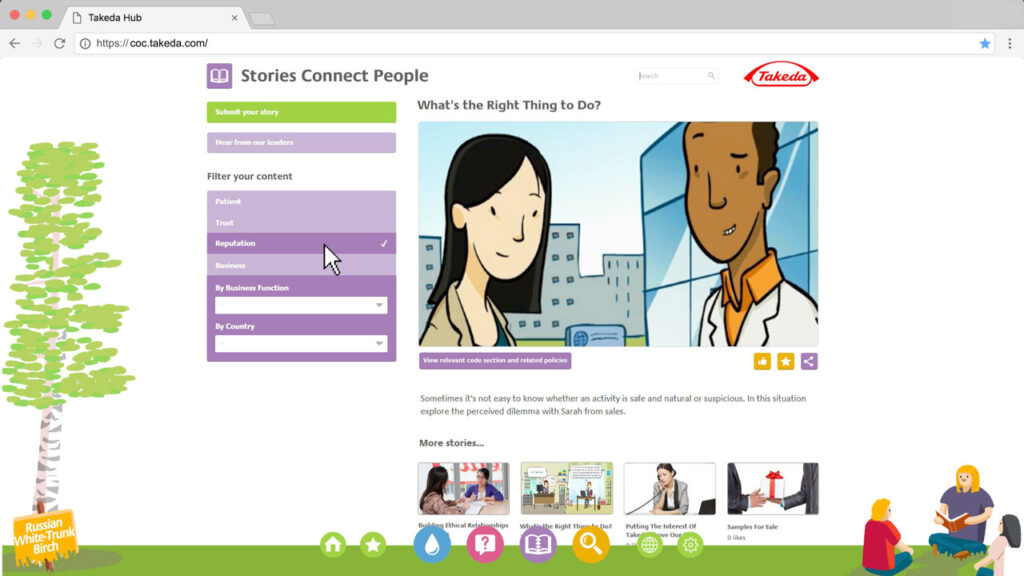
Screenshot of a Takeda e-learning portal titled “Stories Connect People,” showing an interactive ethics and compliance learning hub with story-based scenarios, content filters, and an animated explainer designed to help employees make informed workplace decisions.

5. E-Learning Makes Consequences Safe

This is where immersive learning comes into its own.
One of its greatest strengths is allowing e-learners to experience realistic consequences without real-world risk.
In our VR cooking experience, learners can split a Hollandaise sauce as many times as they need without wasting expensive ingredients or without someone looking over their shoulder.

In our cold water shock simulation, they can experience the panic of rapid breathing and an elevated heart rate without ever being in danger.
Failure becomes part of the learning process rather than something to avoid. E-learners build confidence because they’ve already experienced what happens when things go wrong.

From Knowledge to Capability

Too often, training measures success by asking:
“Can the learner remember this?”
A better question is:
“Can the learner do this when it matters?”

Someone can understand a policy without being able to apply it under pressure. Someone can pass a quiz without feeling confident enough to make the right decision in a real situation. Whether it’s rescuing a Hollandaise sauce before it splits, responding calmly during the first minute of cold water shock or handling a difficult conversation with a customer, people succeed because they’ve practised making decisions, experienced realistic consequences and built confidence in a safe environment.

If you want training to create real behaviour change, ask yourself:

  • Are learners solving realistic problems?
  • Do they understand what’s at stake?
  • Are they challenged at the right level?
  • Are they encouraged to apply what they’ve learned afterwards?
  • Can they fail safely and learn from the experience?

If the answer to several of these questions is “no”, your training may be delivering information without building capability.

When e-learners are given meaningful problems to solve, clear goals to pursue, challenges matched to their abilities and opportunities to apply what they’ve learned, training becomes far more than a compliance exercise. It becomes preparation for real life. Because information doesn’t change behaviour. Experience does.

Sliced Bread has been building  e-learning experience for over two decades. If you have a training challenge in your organisation, a compliance obligation to meet, a skill to develop, or a behaviour to change — we can help turn that it an effective and memorable experience.

Feel free to drop us an email at info@sbanimation.com, or give us a call on +44 (0)207 148 0526. We would be happy to help.

We also post industry related content to our LinkedIn company page, why not give us a follow?

Recent Posts