Convert Your Manual into E-Learning People Will Actually Learn From

Your Manual Is Not a Course. Here’s How to Turn a Manual into E-Learning and Something People Actually Learn From.

To turn a Manual into e-learning starts with a document. Usually a big one. A policy pack. A product manual. A technical specification that someone, somewhere, has spent months perfecting. Then comes the ask – ‘Can you turn this into an eLearning course?’

And this is where the path usually forks. One road leads to a slide-based replica of the document, perhaps with a quiz bolted on at the end. The other leads somewhere far more interesting- a elearning experience that transforms passive reading into active doing.

The difference between those two roads is not technology. It is thinking. And it is that process we want to share with you here.

The Problem with Turning a Manual into E-Learning

We recently watched a presentation that opened with a compelling hook: a NATOPS Flight Manual for the US Navy’s F-14D aircraft. One document. Eleven chapters. 1,037 pages.

The audience was asked to guess the page count before the answer was revealed. The gasps were audible. And the point landed perfectly as this is what organisations routinely hand to their people and call training.

A document is not a learning experience. Knowing that something exists is not the same as being able to do it.

The real challenges that conventional that turning a manual into e-learning creates are well known to anyone who has sat through a click-through course:

  • Low engagement and passive consumption – learners read, click next, and forget
  • Poor knowledge transfer – it is hard to apply what you have only read about
  • One-size-fits-all delivery – no adaptation for role, experience level, or context

These are not problems created by the content. They are problems created by the conversion process. Specifically, by treating ‘turning a manual into a course’ as a formatting task rather than a design task.

Content Is Not the Course. The Experience Is.

The shift that changes everything is deceptively simple: stop thinking about your content as the product, and start thinking about the learning experience as the product.

Your manual, your policy document, your product specification, these are source material. They contain the knowledge that needs to transfer. But the mechanism of that transfer is the experience you design around them, not the documents themselves.
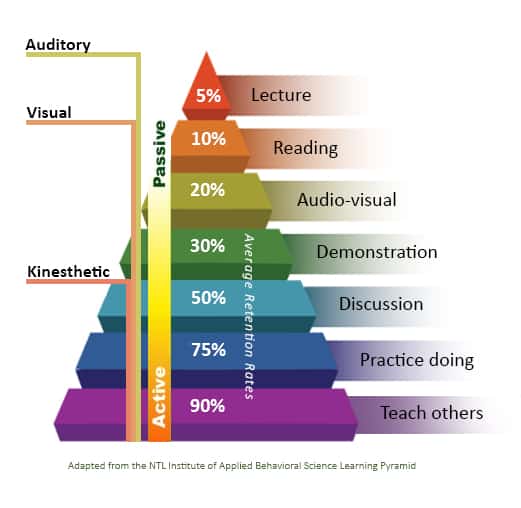
Colourful pyramid diagram illustrating the Learning Pyramid model, showing average retention rates for different teaching methods. From top to bottom: Lecture (5%), Reading (10%), Audio-visual (20%), Demonstration (30%), Discussion (50%), Practice Doing (75%), and Teach Others (90%). The left side labels learning styles as Auditory, Visual, and Kinesthetic, and marks Passive to Active engagement levels. For understanding how to convert a manual into E-Learning.

The Core Distinction – Content tells learners what they need to know. Experience gives learners the opportunity to practice what they need to do. The most significant gains in retention, performance, and error reduction come from the shift from the former to the latter.

This means that ‘reframing the content’ to use the language of instructional designers is not about simplifying or summarising your source material. It is about identifying what learners need to be able to do, and then designing the conditions in which they practice doing it.

Manual into E-Learning: What ‘Learning by Doing’ Actually Looks Like

Active learning is not a single format. It is a design philosophy that can be expressed across a range of approaches, each suited to different content types, learner contexts, and performance outcomes. The most effective include:

Interactive simulations

Rather than describing a procedure, the learner performs it — in a high-fidelity digital replica of the environment where it will actually happen. The F-14 example is instructive here: rather than reading about an engine start-up procedure across seventeen steps of text, a learner navigates the actual cockpit, makes decisions, and experiences the consequences of those decisions in a safe environment. The learning is embodied, not abstract.

Scenario-based learning

Scenarios place learners inside realistic situations drawn directly from their work context. Instead of reading a policy, they encounter a situation that tests their application of it. Instead of memorising a product feature, they respond to a customer question that requires them to use it. The knowledge becomes purposeful because the context makes it so.

Gamification with purpose

Not points and leaderboards for their own sake, but the application of challenge, consequence, and progression mechanics that mirror how people actually develop mastery. Difficulty increases as competence grows. Failure is informative rather than terminal. Progress is visible and meaningful.

SCORM-compliant, LMS-ready delivery

All of the above can be packaged and delivered as SCORM-compliant content that integrates with your existing Learning Management System. The experience is immersive. The infrastructure is familiar. You do not need to rebuild your technology ecosystem to deliver genuinely effective learning.

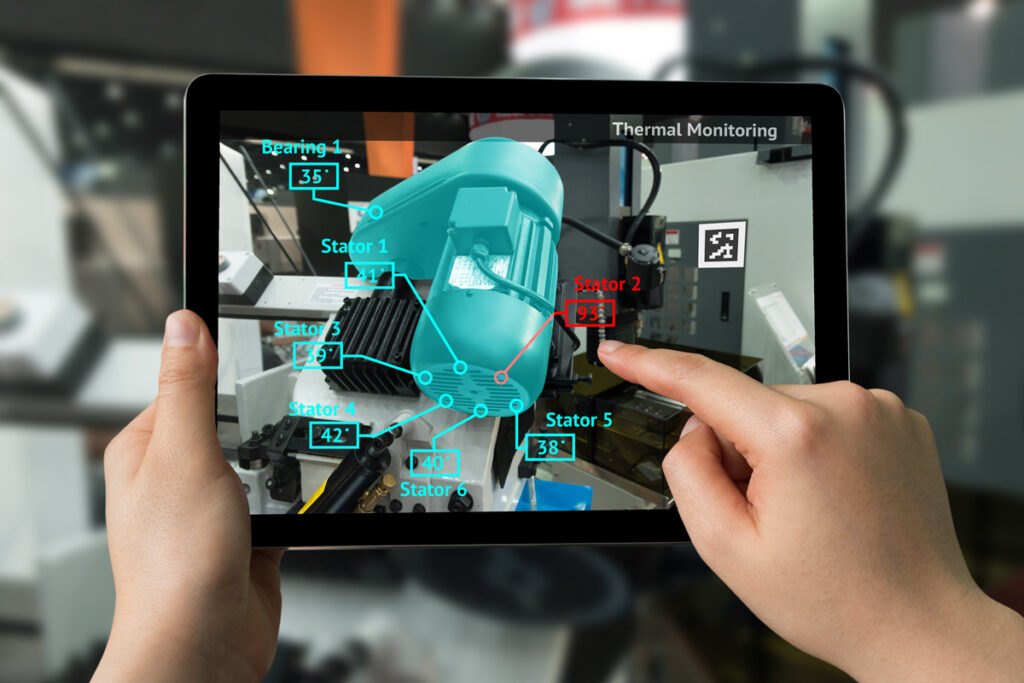
A person holding a tablet that shows an engine in AR identifying different parts of an engine for a manual into e-learning blogpost.

Why It Makes a Measurable Difference

This is not a case for the aesthetically appealing or the technically impressive. When learning is designed as an active (participant) experience rather than a passive consumption event, the results are consistently and significantly better – that is a known fact!

50%+ Retention Uplift

Learners retain significantly more when they practice applying knowledge rather than reading about it. Active learning consistently outperforms passive formats on both immediate and delayed recall measures.

Fewer Errors on the Job

When learners practice procedures in simulated environments before performing them in real ones, error rates drop. They have already made the mistakes — safely — and learned from the consequences.

Better Sustained Performance

The gains from active learning do not fade quickly. Because knowledge is encoded through experience rather than exposure, it is more readily recalled and applied when it matters.

How We Do It: The Sliced Bread Approach to

Transforming a large body of content into a compelling learning experience follows a clear and repeatable process. It is rigorous, collaborative, and designed to protect what matters in your source material while unlocking what it has never been able to do on its own.

  • 01 Identify Critical Skills: We start not with your document, but with your people. What do they need to be able to do? What decisions do they face? What errors are you trying to prevent? The answers define the shape of the learning experience before a single screen is designed.
  • 02 Define Objectives: Each learning objective is written as a performance outcome, not a knowledge statement. Not ‘understand the procedure’ but ‘correctly execute the procedure under time pressure’. The difference in specificity changes everything downstream.
  • 03 Analyse Materials: Your source content is interrogated for what it must teach, what it can be simplified, and what is better shown than described. This is where the instructional design work begins in earnest.
  • 04 Design the Experience: Interactive scenarios, simulation flows, challenge structures, and branching logic are designed to carry the learning. Every interaction has an instructional purpose. Nothing is decorative.
  • 05 Develop and Test: SCORM-compliant content is built, tested with real learners, iterated, and delivered into your LMS. Data from learner interactions informs further refinement.

Manual into E-Learning: The Simplest Offer Is Sometimes the Most Compelling One

It is easy to be distracted by the latest technology in learning such as: immersive VR environments, AI-driven personalisation, spatial computing. These things are exciting, and many of them are genuinely transformative. But sometimes the most compelling offer is also the most grounded one.

You have content. You need people to be able to use it. We turn one into the other.

If your organisation is sitting on a manual, a product guide, a compliance framework, or a technical specification that your people are expected to learn from but quietly ignore, this is the conversation worth having.

Because the gap between knowing and doing is exactly what we know best!

Want to see what this looks like for your content?

We would love to show you how we turn your most complex material into an experience your people will actually complete and remember.

Get in touch with the Sliced Bread team.

ELEARNING | INSTRUCTIONAL DESIGN | LEARNING TRANSFORMATION

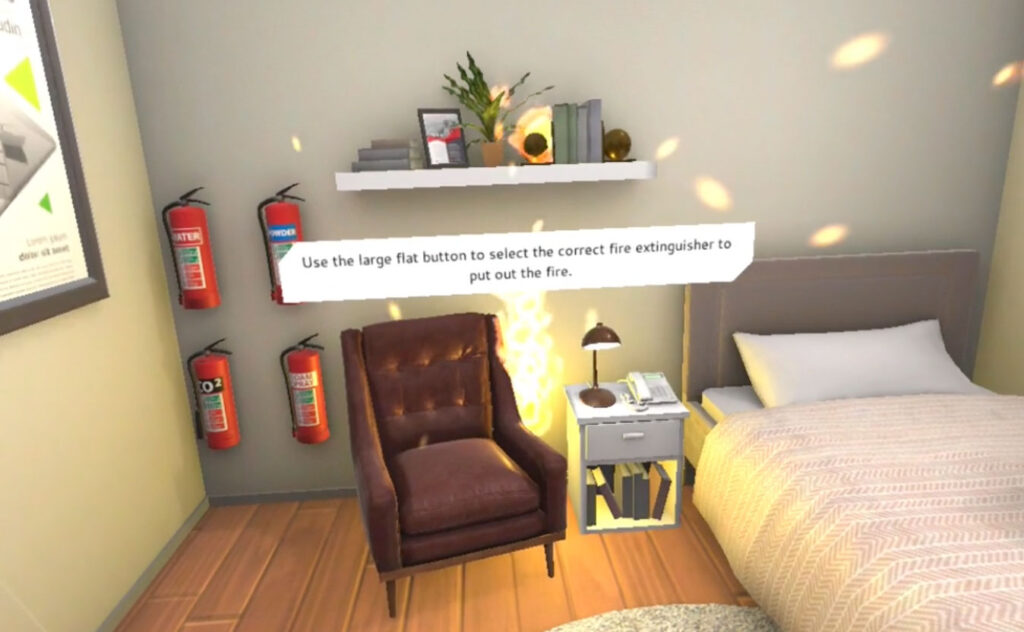
Still from VR Fire Safety training of a hospital room with the plug socket on fire, and the text 'Use the large flat button to select the correct fire extinguisher to put out the fire. As part of a manual into e-learning process.

Elearning FAQs

1. What is the difference between content and elearning?

Content provides information, but elearning is about creating an experience that helps learners apply that information. Effective elearning focuses on what people need to do, not just what they need to know.

2. Why doesn’t turning a manual into e-learning always work?

Simply converting a document into slides often leads to passive learning. Without interaction or real-world context, learners are less likely to retain information or apply it in practice.

3. How does “learning by doing” improve elearning outcomes?

Learning by doing allows learners to practice tasks, make decisions, and see consequences in a safe environment. This leads to better retention, fewer errors, and stronger real-world performance.

4. What types of elearning experiences are most effective?

The most effective elearning includes interactive simulations, scenario-based learning, and structured challenges. These approaches move beyond passive reading and encourage active participation.

5. Can complex technical content be turned into engaging elearning?

Yes. Even highly detailed manuals or technical documents can be transformed into engaging elearning by focusing on key tasks, decisions, and real-world application rather than simply presenting information.

6. Does interactive elearning still work with existing LMS platforms?

Absolutely. Modern interactive elearning can be delivered as SCORM-compliant content, meaning it integrates seamlessly with existing Learning Management Systems without requiring new infrastructure.

7. What are the benefits of transforming a manual into e-learning experiences?

Well-designed elearning leads to higher engagement, improved knowledge retention, and better on-the-job performance. It helps bridge the gap between knowing and doing.

8. How do you start turning a manual into e-learning?

The process begins by identifying what learners need to be able to do, not just what they need to read. From there, the content is reshaped into interactive experiences that support real-world application.

Recent Posts