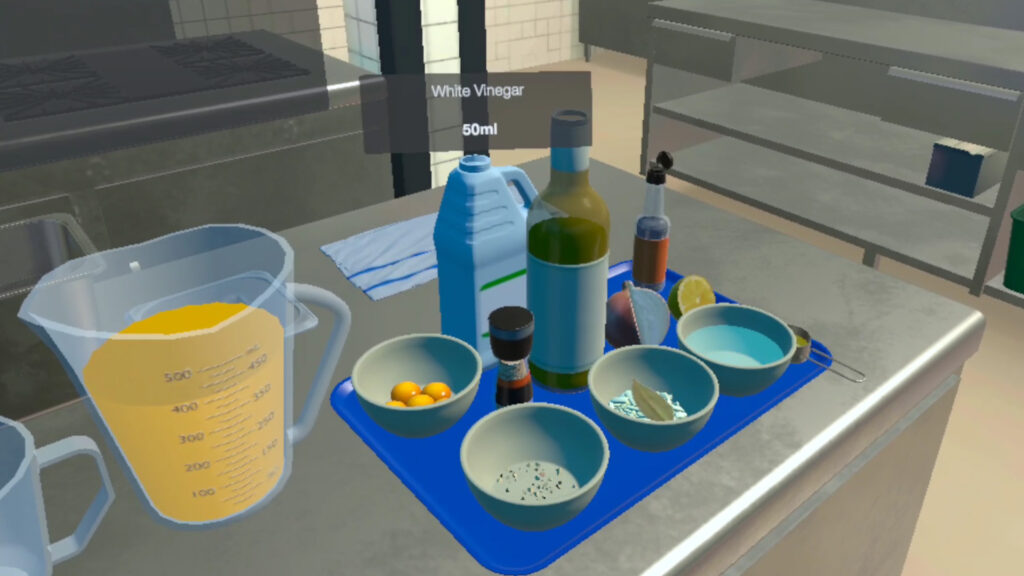
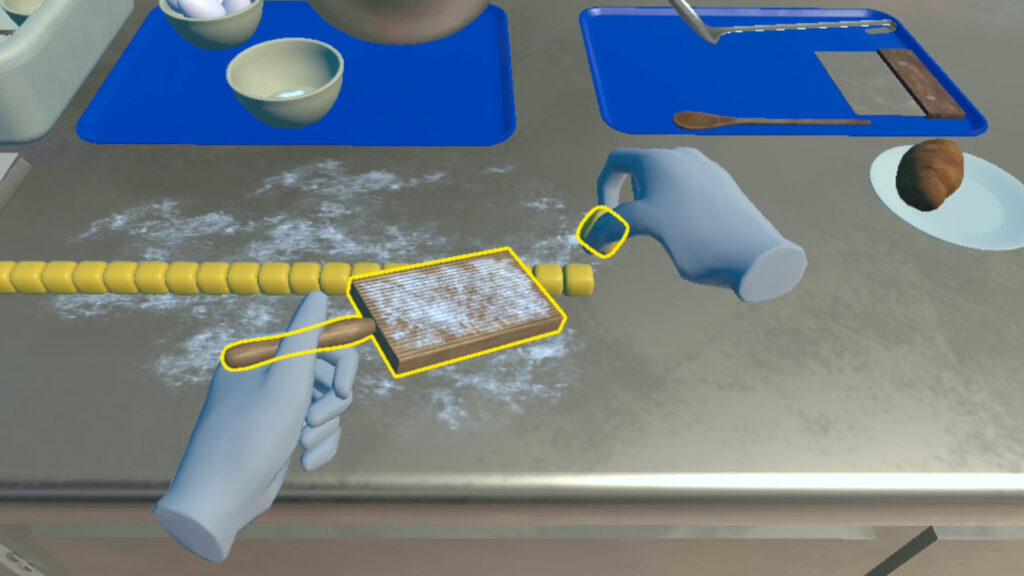
Design decisions that made the difference in VR Cooking
Several specific design choices in the VCC application illustrate the principles that make VR cooking educationally effective rather than simply entertaining.
- Point-of-view reference footage: each recipe was filmed from the chef’s perspective as a primary design reference, ensuring the VR experience reflected the actual physical experience of cooking rather than an observer’s view.
- Voiceover aligned with instruction: the in-application voiceover was developed in collaboration with the chef to include not just procedural steps but the contextual knowledge a student would absorb from a skilled instructor — the why behind each technique, not just the what.
- Progressive difficulty: after completing the guided recipe modules, students can test themselves at advanced difficulty levels where the margin for error narrows and the timing demands increase. This mirrors the progression from teaching kitchen to professional environment.
- Visual feedback for invisible processes: for techniques where the critical information is not visually obvious — such as the flavour balance in ceviche — we built interactive visualisation tools that make the invisible visible, giving students a way to internalise concepts that would otherwise require years of tasting experience to develop.
Students who completed the VCC VR cooking programme found it a genuinely valuable and rewarding learning experience. The chef who collaborated on the project noted that the application had captured not just the procedural steps of each recipe, but the nuances and details he had discussed throughout developmentthe kind of knowledge that typically only passes from experienced practitioner to student through years of direct supervision.
VR Cooking We Can Build for Your Organisation
The VCC application demonstrates what is possible when VR cooking is approached as a serious instructional design challenge and the same methodology can be applied across a range of culinary and hospitality training contexts.
Culinary colleges and vocational training providers
If your institution delivers culinary programmes at scale, VR cooking allows you to give every student meaningful practical experience regardless of kitchen availability, class size, or ingredient budget. Modules can be built around your specific curriculum, reflecting the recipes, techniques, and assessment criteria your programme uses.
Hotel and restaurant groups
For hospitality operators training kitchen staff across multiple sites, VR cooking delivers consistent, on-demand training that does not depend on the availability of a senior chef to demonstrate. New starters can build foundational technique before their first service. Existing staff can be trained on new menu items or standardised processes without pulling kitchen resource.
Food manufacturers and product training
Beyond the restaurant kitchen, VR cooking has applications wherever practical food preparation training is required at scale from food manufacturing induction programmes to chef ambassador training for ingredient brands and suppliers.
What every project starts with
Regardless of context, our approach to VR cooking projects follows the same principles that made the VCC application effective: start with the learning objective, not the technology. Identify the critical technique moments in your curriculum. Design the simulation around what the learner needs to understand, feel, and practise. Build in appropriate failure states and feedback mechanisms. And test with real learners before finalising.
VR Cooking of Tomorrow
VR cooking is not a novelty. The research is clear that it improves learning outcomes for practical culinary skills. The VCC project demonstrates that it can be built to the standard of quality that vocational educators and their students require. And the operational case for culinary training providers, hospitality operators, and food businesses is compelling – more practice time, lower ingredient waste, consistent delivery at scale, and students who arrive at real kitchen environments genuinely better prepared.
The question is what the right VR cooking experience would look like for your curriculum, your learners, and your training challenge?
Talk to us about your VR cooking project
Whether you are a culinary college, a hospitality operator, or a food business looking to improve how you train, we can design and build a VR cooking experience around your specific curriculum and learners.
Click here to get in touch with the Sliced Bread team.
REFERENCES
1. VR training for practical skills — significant moderate positive effect (2024 meta-analysis, International Journal of STEM Education): Sliced Bread VR Cooking blog, 2025. sbanimation.com/virtual-reality-cooking
2. Impact of culinary VR curriculum on learning outcomes and acceptance (82 students): Innovations in Education and Teaching International, 2023. tandfonline.com/doi/10.1080/14703297.2023.2287583
3. VR in hospitality and tourism education (317 students, 2024-2025): Springer / International Conference on Frontiers of Educational Technologies, 2025. link.springer.com/chapter/10.1007/978-981-95-2521-8_9
4. Systematic literature review on VR in culinary education (50 articles, 2018-2025): Jurnal Inovasi dan Teknologi Pembelajaran, 2025. journal-fip.um.ac.id/jinotep/article/view/2311
5. VCC culinary VR application cited in academic literature: ResearchGate / culinary VR curriculum impact study, 2023. researchgate.net/publication/376017757
VCC project details drawn from Sliced Bread case study: sbanimation.com/case-studies/vr-training-for-cooks/