Healthcare Education in Practice: From Medical Animation to Immersive Learning and AI

Healthcare education can take many forms. Over the years, we have created everything from 3D medical animations explaining complex mechanisms of action to interactive e-learning, gamified learning experiences, virtual reality training and, more recently, AI-powered conversations with realistic virtual characters. But what technology to use is rarely where we start.

We ask – what does someone need to understand, practice or do differently as a result of the experience?

We have been working with healthcare and pharmaceutical organisations for more than two decades, including global brands such as Takeda, GSK, Pfizer, Bayer, Novartis, and Merck. During that time, the possibilities for healthcare education have changed enormously.

A subject that might once have been explained through a medical animation can now become an interactive experience. Learners can make decisions, explore consequences, practise conversations or step inside an immersive environment. Sometimes, of course, an animation is still exactly the right answer.

So rather than looking at healthcare education in theory, we wanted to share some of the ways we have actually approached it, and why different learning challenges call for very different solutions.

Making complex healthcare information easier to understand

One of the main challenges in healthcare education is explaining the complex. Whether the audience is healthcare professionals, patients, pharmaceutical sales teams or internal employees, there can be a huge amount of information to communicate. Anatomy, disease pathways, mechanisms of action, clinical data and treatment pathways can be difficult to understand from words and diagrams alone. This is where medical animation remains an incredibly useful tool.

We’ve produced medical and pharmaceutical animation for many years, using 2D and 3D animation to take viewers inside the human body, visualise processes that cannot be seen and explain how treatments and medical devices work.

The value isn’t simply making complex information look attractive. Good 3d medical animation allows us to control exactly what the audience sees, when they see it and how much information they need to process at once.

A complex biological process can be stripped back to its essential components. The camera can travel somewhere that would be impossible in real life. Microscopic processes can be made visible and relationships between different pieces of information can be demonstrated rather than described. For some healthcare education challenges, that clarity is exactly what is needed. But understanding something is not always the same as being able to apply it.

Moving healthcare e-learning beyond click-and-continue

E-learning gives healthcare organisations an obvious advantage: it can provide consistent education to large, geographically dispersed audiences.

But there is an equally obvious problem as it is very easy for digital learning to become passive.

Read some information. Click Next. Answer a multiple-choice question. Repeat. We have increasingly designed our healthcare e-learning around decisions, scenarios and interactions rather than simply presenting information.

For Takeda, for example, we developed a gamified learning experience that turned the learner journey into something closer to an adventure. Progress through the content was represented visually, with challenges, destinations and achievements forming part of the overall experience. The important part wasn’t simply adding game mechanics.

The gamification gave the learning a structure and a sense of progression. It provided a reason to keep exploring and created opportunities to turn learning objectives into challenges.

This is an approach we use increasingly across e-learning – give the learner something meaningful to do with the information. That could mean making a clinical decision, identifying a risk, exploring a branching scenario or seeing the consequences of a choice.
Using immersive learning when people need to experience something

There are some things that are difficult to teach effectively on a screen and this is where immersive learning becomes particularly interesting.

Virtual and augmented reality allow us to move from explaining an environment or situation to placing somebody inside it.

We’ve explored this across healthcare and pharmaceutical projects, creating experiences that allow learners to interact with information spatially rather than simply consuming it. For pharmaceutical engagement, for example, an immersive medical experience can allow someone to explore a condition, treatment or mechanism in a way that simply isn’t possible with a conventional presentation.

Rather than watching an animation of something happening, the learner can be surrounded by it. XR isn’t valuable simply because putting on a headset feels novel. Its real strength is learning by doing.

Learners can practise procedures, explore environments, manipulate objects, make decisions and repeat an experience without the risks, costs or practical limitations associated with doing the same thing in the real world. That makes immersive learning particularly interesting when the objective goes beyond knowledge transfer and into skills, confidence and behaviour.

Creating healthcare education people can interact with

Not every immersive experience needs a headset. We’ve also developed augmented reality and interactive experiences that bring digital information into physical environments.

This can be particularly useful for healthcare education at events, congresses and exhibitions, where the challenge isn’t necessarily delivering a formal training programme. It is getting somebody interested enough to stop, explore and engage with the subject.

Touchscreens, interactive 3D models, AR experiences and gamified installations can transform healthcare content from something audiences are presented with into something they actively investigate.

And this is where our background in animation and interactive development becomes particularly useful. A 3D medical animation doesn’t necessarily have to remain a video. The same assets can potentially become part of an interactive model, an AR experience or an immersive environment. Increasingly, we think about healthcare content as an experience rather than a format.

AI is creating another type of healthcare learning experience

More recently, we’ve been exploring another significant shift – AI-powered role-play and this is particularly exciting because conversation is at the heart of so many healthcare and pharmaceutical roles.

Managers need to handle difficult conversations. Healthcare professionals need to communicate complex or sensitive information. Sales and medical teams need to listen, respond and adapt rather than simply recall information.

Traditionally, practising these skills requires another person. We have been developing learning experiences that combine conversational AI with realistic virtual characters, including Unreal Engine MetaHumans. Instead of choosing from a predefined set of responses, the learner can actually talk to the character.

The character listens, responds and allows the conversation to develop dynamically which creates a fundamentally different type of e-learning.

A learner can practise an uncomfortable conversation privately, make mistakes without consequence and try again. The experience can then evaluate aspects of the interaction and provide feedback.

For one pharmaceutical project, we have been developing AI-driven manager training around exactly this principle. Learners interact with different personalities and need to adapt their approach to the individual in front of them.

There isn’t necessarily one perfect sentence to choose from a list and the skill lies in the conversation itself. For us, this is one of the most interesting developments in digital learning because AI isn’t simply being used to generate content more quickly. It is becoming part of the learning experience.

Healthcare education isn’t always for healthcare professionals

It is also worth remembering that healthcare education has a much broader audience. Patients and the public frequently need to understand complicated subjects at moments when clarity is particularly important.

What is happening to me? How does this treatment work? What am I expected to do? What happens next? The same principles apply here, but the communication challenge can be very different.

Medical terminology may need to be removed or carefully explained. Visual communication becomes particularly important. Accessibility needs to be considered from the outset. And above all, the experience needs to respect the person receiving the information.

Animation can make an invisible process understandable. Interactive content can allow people to explore information at their own pace. Immersive experiences can demonstrate something rather than relying on lengthy instructions.

The technology changes, but the communication principle remains remarkably consistent which is to make the complicated understandable without making it inaccurate.

Choosing the right technology for healthcare education

With so many options now available, it can be tempting to begin a project by deciding on the technology.

“We want a VR experience.”

“We need an AI solution.”

“We’d like to gamify this.”

Sometimes there is a perfectly good reason for starting there. But wherever possible, we prefer to go back a stage.

What does the audience actually need to do?

  • If somebody needs to understand a complex biological process, 3D medical animation might be the answer.
  • If they need to remember and apply information, interactive or gamified e-learning might work better.
  • If they need to practise something physical or experience an environment, immersive VR or AR may be appropriate.
  • If they need to develop conversational skills, an AI-driven character could offer something conventional e-learning cannot.

And sometimes the strongest solution combines several of these.

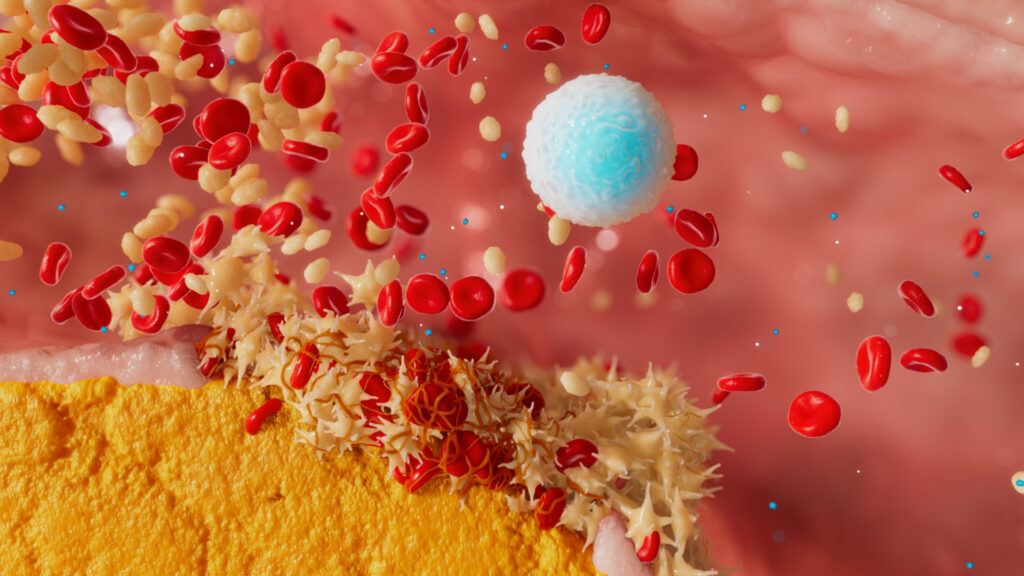
3D medical animation showing red blood cells and white blood cell flow inside an artery – created by Sliced Bread Animation for healthcare education

More than one way to create better healthcare education

After more than two decades working across healthcare, pharmaceutical and medical communications, one of the biggest changes we’ve seen is the expansion of the creative toolkit available to us.

Animation is still fundamental to much of what we do. But today, an animation can sit within an e-learning experience, become part of a VR simulation, appear within augmented reality or provide the visual foundation for an interactive application.

Likewise, e-learning doesn’t have to mean slides and multiple-choice questions. It can involve narrative, gamification, simulation, branching decisions and now conversations with AI characters.

The interesting question isn’t “Which technology should we use?”

It’s “What experience will help this audience learn?”

At Sliced Bread Animation, that’s the part we enjoy most. Looking for a different approach to healthcare education?

Whether you’re starting something new or have existing healthcare education that could do with a refresh, we’d be happy to explore what might work.

From medical animation and pharmaceutical animation to e-learning, gamification, VR, AR and AI-powered training, we design and develop experiences around the people who actually need to use them.

Talk to us about your healthcare education project.

Recent Posts