Why VR Training for Hospitality Skills Development Makes Sense

Looking to scale up service, safety, and customer-facing skills? Then VR training for hospitality is the most practical way to develop a basic foundation for new recruits. The UK government has announced a funded initiative to help get 16 – 21 years into, or back to work.

Demand for staff is rising, expectations around service and safety are higher than ever, and many employers are being asked to support younger people entering the workforce with limited prior experience.

Against this backdrop, training methods matter. Employers need approaches that are engaging, repeatable, and realistic, while still being cost-effective and scalable. This is where VR training for hospitality is starting to play a meaningful role.

VR Training for Hospitality Is About More Than Cooking

When people think about training in hospitality, cooking is often the first thing that comes to mind. In reality, the sector depends on a much broader set of skills. Front-of-house service, customer interaction, health and safety, hygiene, teamwork, and dealing with pressure are just as critical as food preparation.

Virtual reality training is well suited to this range of skills because it allows learners to experience realistic situations without the risks or costs of live environments. VR can be used to support:

  • Service training such as laying and waiting on tables
  • Front-of-house customer interaction and communication
  • Handling difficult or confrontational customers
  • Hazard awareness, hygiene, and safety procedures
  • Understanding service flow and expectations

These are areas where confidence and decision-making matter as much as technical ability. VR training allows learners to practise responses, make mistakes, and try again in a controlled setting.

Why VR Training For Hospitality Works for Young Learners

Many young people entering hospitality roles have limited exposure to real workplace environments. For those who are new to work, or returning to learning after time away, traditional classroom-based training can feel abstract and disconnected from reality.

VR training for hospitality bridges that gap. It places learners inside realistic scenarios where they can see, hear, and respond to situations as they would in the real world. This helps them build familiarity before they ever step onto a shop floor, into a restaurant, or behind a bar.

For learners who may lack confidence, VR training for hospitality offers a safe space to practise without fear of embarrassment or consequences. For employers, it provides a consistent training experience that does not rely on staff availability or busy service periods.

Introducing the Learning Triangle

Rather than replacing existing training methods, VR is most effective when used as part of a wider learning approach. One way to think about this is through a simple learning triangle:

1. Virtual Training

This includes virtual reality, augmented reality, and structured e-learning. At this stage, learners are introduced to environments, scenarios, and expectations. They can repeat tasks, explore consequences, and build understanding at their own pace.

2. Practice-Based Training

This might involve role-play with actors, simulated service scenarios, or working with dummies and training setups. Here, learners begin to apply what they have seen in virtual environments, developing confidence and communication skills.

3. Work Experience

Finally, learners move into real workplaces, placements, or apprenticeships. By this stage, they are better prepared, more confident, and more aware of what is expected of them.

Used together, these three elements reinforce one another. Virtual training prepares learners, practice builds confidence, and real-world experience consolidates skills.
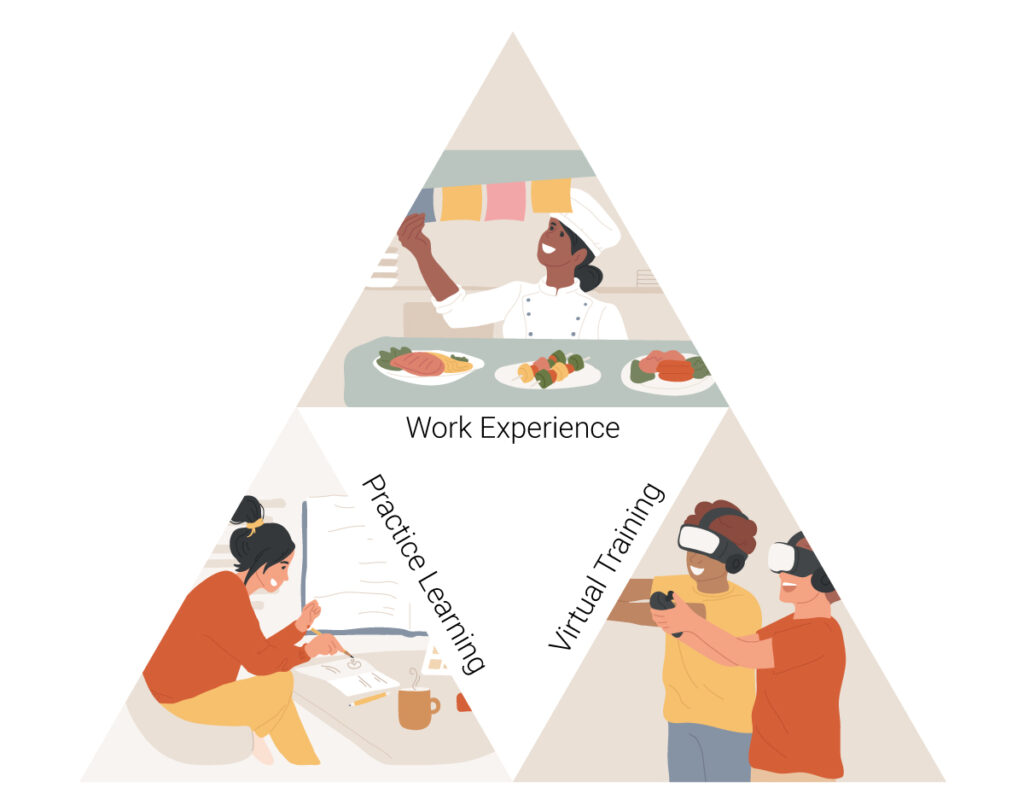

Illustrated learning triangle showing VR training for hospitality, practice-based learning, and work experience, demonstrating how immersive training prepares students for real-world hospitality roles.

Supporting Employers and Training Providers

For hospitality employers, VR training offers a way to support new entrants without increasing pressure on already stretched teams. Scenarios can be standardised, repeated, and updated as requirements change. Training can happen off-peak, away from customers, and without disrupting service.

For colleges, training providers, and organisations supporting government initiatives, VR can help scale delivery while maintaining quality. It provides a consistent foundation before learners move into placements or apprenticeships, helping reduce drop-out rates and improve readiness.

A Practical Response to VR Training For Hospitality

As the UK focuses on tackling youth unemployment and skills gaps in hospitality, the conversation is shifting from simply creating opportunities to ensuring people are genuinely prepared for them. Virtual reality training is not a silver bullet, but it is a practical tool that fits well within modern training strategies.

By combining immersive virtual learning with hands-on practice and real work experience, the hospitality sector can offer training that is more engaging, more inclusive, and better aligned with the realities of the job. For learners, it builds confidence. For employers, it builds capability. And for the industry as a whole, it supports a more sustainable approach to skills development.We have seen this first-hand through our work on VR training for hospitality, particularly in cooking and kitchen-based roles.

Our VR cooking experiences allow students to step into a realistic kitchen environment, practise procedures, understand timing and sequencing, and become familiar with professional workflows before they ever enter a live kitchen.

By removing the pressure of real service, learners can build confidence, develop muscle memory, and make mistakes safely. When they move into practical training or work experience, they arrive better prepared, more aware of expectations, and more comfortable operating in a professional setting.

Professional chefs plating food in a commercial kitchen, focusing on presentation and precision during culinary training. VR training for hospitality.

We have seen this first-hand through our work on VR training for hospitality, particularly in cooking and kitchen-based roles.

Our VR cooking experiences allow students to step into a realistic kitchen environment, practise procedures, understand timing and sequencing, and become familiar with professional workflows before they ever enter a live kitchen. By removing the pressure of real service, learners can build confidence, develop muscle memory, and make mistakes safely.

When they move into practical training or work experience, they arrive better prepared, more aware of expectations, and more comfortable operating in a professional setting.

Contact Us About VR Training For Hospitality

Are you looking to create a VR training for hospitality experience that uses gamification mechanics for effective learning and engagement? Then feel free to drop us an email at info@sbanimation.com, or give us a call on +44 (0)207 148 0526. We would be happy to help.

If you are unfamiliar with the virtual reality production process, this blog post What to expect when you work with Sliced Bread might serve to help you, it provides a complete guide on how we typically approach our projects, from concept to final delivery. It also provides information on how we structure our fees and plan the production schedule.

We also post industry related content to our LinkedIn company page, why not give us a follow?

Recent Posts