Elearning That Delivers Results

At Sliced Bread Animation, we have spent over two decades working with organisations to improve how they communicate, train, and engage their people. Over that time, one thing has become clear. Elearning only works when it is engaging.

Too often, elearning is created quickly, delivered once, and forgotten. Learners click through slides, complete a quiz, and move on without retaining much of what they have seen. The challenge is not access to training. It is making that training meaningful.

Our approach to e-learning is built around a simple idea: people learn best by doing.

This principle underpins everything we create, from interactive modules and scenario-based training to gamified learning experiences and animated content. It is how we move beyond passive learning and create something that sticks.

The Challenge with Traditional Elearning

E-learning has clear advantages. It is flexible, scalable, and accessible across organisations of all sizes. In fact, research shows that over 75% of learners feel more engaged when using e-learning platforms.

But there is a catch.

Without careful design, e-learning can quickly become disengaging. Static slides, dense text, and linear structures often fail to reflect how people actually learn. The result is low retention, limited behaviour change, and poor return on investment.

We see this regularly when clients come to us. The content exists. The intent is there. But the experience is not working.

Our Approach: Elearning by Doing

We design e-learning experiences that place the learner at the centre. Rather than simply presenting information, we create environments where users:

  • Make decisions
  • Explore consequences
  • Test their understanding
  • Build confidence through interaction

This is where e-learning becomes more than content delivery. It becomes a safe space to practise.

Scenario-based training is a good example of this. By allowing users to see the outcomes of their decisions, we help them adapt more quickly than they would in real-world situations, without the pressure of getting it wrong.
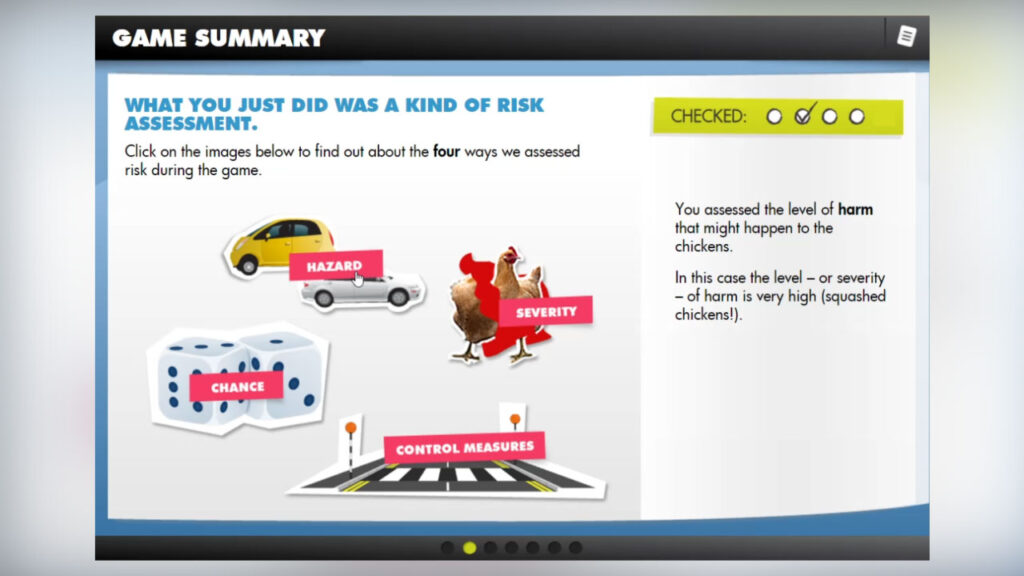
A 'Game Summary' screen from an educational game about risk assessment. The main text at the top reads 'WHAT YOU JUST DID WAS A KIND OF RISK ASSESSMENT.' It instructs the user to click on images to learn about the four ways risk was assessed during the game.

Designing for Engagement and Retention

Effective elearning is not about adding interactivity for the sake of it. It is about using the right techniques to support learning outcomes and ensure knowledge is retained and applied in real-world situations.

One of the biggest challenges we see in elearning is maintaining attention. Learners are often balancing training alongside busy schedules, so content needs to be relevant, clear, and engaging from the outset. This is achieved by encouraging active participation through scenario-based interactions, decision-making, and meaningful moments of input, rather than passive clicking.

Retention comes from structure and clarity. Breaking content into digestible sections, using visual storytelling to simplify complex ideas, and reinforcing key messages through interaction all help learners remember and apply what they have learned.

When elearning is designed with engagement in mind, it moves beyond information delivery and becomes an experience that drives real understanding and behaviour change.

We often combine several approaches within a single programme, here’s some examples:

Scenario-Based Elearning

Learners are placed into realistic situations where their choices shape the outcome. This is particularly effective for soft skills, compliance, and decision-making.

Having a safe environment to make mistakes helps to relieve trainees of pressure. But scenario-based training can be taken much further. Because users are immersed in an experience, it is an efficient training method that enables users to adapt to situations much more quickly than they would in real-life.

Gamified Experiences

We integrate game mechanics such as progression, rewards, and challenges to increase motivation. Studies show gamification can increase engagement and reduce dropout rates significantly.

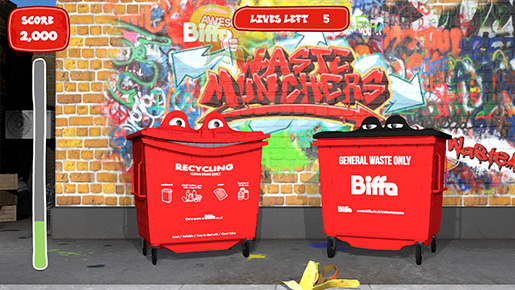
A good example of this is our waste Munchers Game for Biffa. Biffa identified an opportunity to develop a fun and interactive approach to learning about waste management through a mobile application game. The game encourages and changes behaviours, and reduce cross contamination when waste organisation, which can produce several benefits such as reducing landfill.

Interactive Modules

From drag-and-drop activities to branching pathways, interactivity keeps learners involved and focused.

Visual Storytelling

Animation plays a key role in simplifying complex ideas and making content easier to understand and remember.

The key is balance. Too little interaction and the content becomes passive. Too much, and it becomes distracting. Our role is to find that middle ground.

Case Study Highlights

Over the years, we have delivered a wide range of e-learning solutions across industries, each designed to solve a specific challenge.

Leadership Development – Danaher (Best People Leaders Programme)

Danaher approached us to improve an existing SCORM-based learning programme that was not delivering strong engagement or retention.

We introduced game-based learning mechanics and interactive scenarios, transforming the experience into something more dynamic and learner-driven. The result was a programme that not only delivered information, but supported real behavioural change.

Compliance Training – Astellas Pharma

For Astellas, we developed compliance modules focused on disclosure and transparency.

Each interaction was carefully designed so learners had to actively engage with the content before progressing. This ensured that critical information was not simply skipped, but understood and applied.

Gamified Elearning – Takeda Code of Conduct

To support Takeda in rolling out their Code of Conduct, we created a gamified learning experience that combined:

  • Drag-and-drop interactions
  • Matching exercises
  • Exploratory navigation

This approach helped turn what could have been a dense topic into something engaging and accessible, improving both completion rates and retention.

Health & Safety Training

In health and safety projects, we have combined humour, problem-solving, and interactive scenarios to create more memorable learning experiences.

Rather than presenting rules, we create situations where learners must think, respond, and understand risk. This leads to stronger knowledge retention and better real-world application. This cemetes our belief of learning-by-doing, in a construction environment, clients are looking for than a tick-box compliance, they often seek to embed new behaviours.

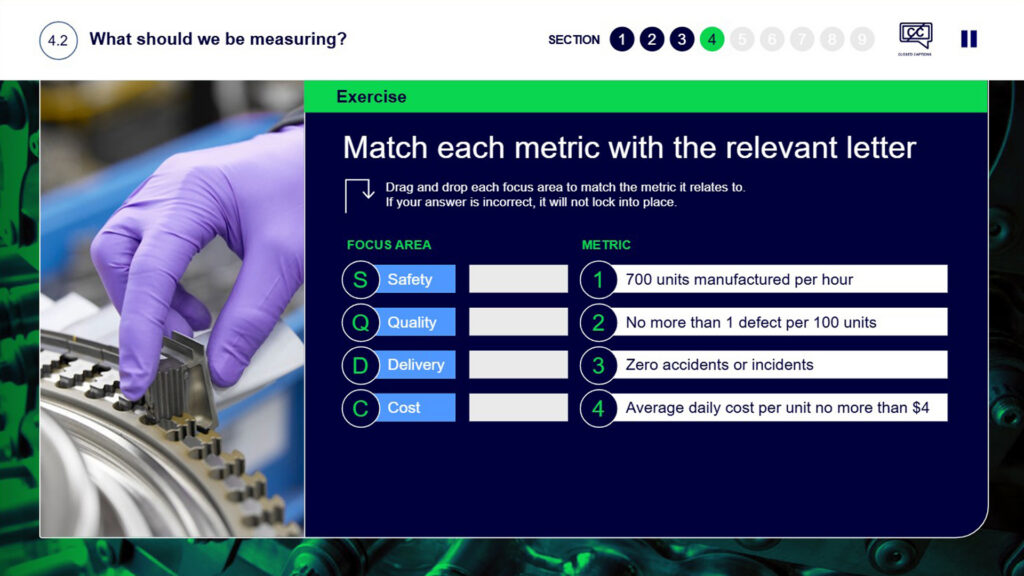
Elearning screen showing an exercise titled “Match each metric with the relevant letter.” Learners drag focus areas—Safety, Quality, Delivery, and Cost—to match metrics such as production rate, defect rate, zero incidents, and cost per unit. A close-up image of a gloved hand working on machinery appears on the left.

Interactive Learning Formats Beyond SCORM

Not all elearning sits neatly within a traditional LMS. While SCORM remains a core delivery format, modern elearning increasingly extends beyond these boundaries to meet learners where they are.

We have developed a range of alternative formats that support different contexts and behaviours, including interactive PDFs that function like “choose your own adventure” experiences, mobile-based learning games designed to encourage behaviour change, and short-form animated modules used for internal communications and awareness.

These approaches allow elearning to become more flexible and accessible, reaching learners across devices, environments, and time constraints. By thinking beyond standard delivery methods, we help organisations create elearning experiences that feel relevant, immediate, and easier to engage with.

How We Build Elearning Experiences

At Sliced Bread Animation approach to elearning is both collaborative and structured, ensuring clarity and alignment at every stage of development. Every project begins with a clear understanding of the learning objectives and the needs of the audience, allowing us to shape content that is both purposeful and relevant.

From there, we develop scripts and interactive storyboards that define how learners will move through the experience, followed by the creation of visual styles and assets that support both engagement and clarity.

As the elearning experience takes shape, we build interactive components and animations that encourage active participation, rather than passively watching. This is supported by a thorough process of testing, refinement, and quality assurance, ensuring that the final product is both technically robust and effective as a learning tool.

Delivery is tailored to the client’s needs, whether as SCORM packages for LMS integration or as web-based solutions for broader accessibility. Throughout the process, we work closely with stakeholders through regular check-ins and clearly defined milestones, ensuring that communication remains strong and the project stays on track.

Measuring Success of Elearning

Elearning should not end at the point of delivery. In many ways, that is where its real value begins. We encourage clients to take a data-led approach to elearning, tracking metrics such as completion rates, engagement time, drop-off points, and assessment performance.

These insights provide a clear picture of how learners are interacting with the content, highlighting both strengths and areas for improvement.

By analysing this data, organisations can refine their elearning over time, improving both effectiveness and return on investment. Continuous improvement is central to successful elearning strategies.

The most impactful programmes are not static. They evolve in response to learner behaviour, feedback, and organisational needs.

Beyond Elearning: The Future of Interactive Training

Elearning is no longer limited to slides, quizzes, and linear modules. It is evolving into something far more dynamic and responsive. We are increasingly blending traditional elearning with immersive environments, AI-driven interactions, conversational training tools, and real-time feedback systems.

These technologies allow learners to engage in more natural, human-like interactions, creating experiences that feel closer to real-world scenarios.

Despite these advances, the core principle remains the same. Effective elearning is built on active participation. When learners are encouraged to interact, make decisions, and explore outcomes, they are far more likely to retain knowledge and apply it in practice.

As elearning continues to evolve, this focus on engagement and experience will remain at the heart of what makes it successful.

Contact our team of experts today to learn more about how our London-based animation studio can produce elearning courses that encourage your employees to learn faster and retain information better.

We’re an award-winning animation and immersive technology studio, creating everything from animated explainer videos, gamified e-learning to XR experiences.

Click here to request a quote

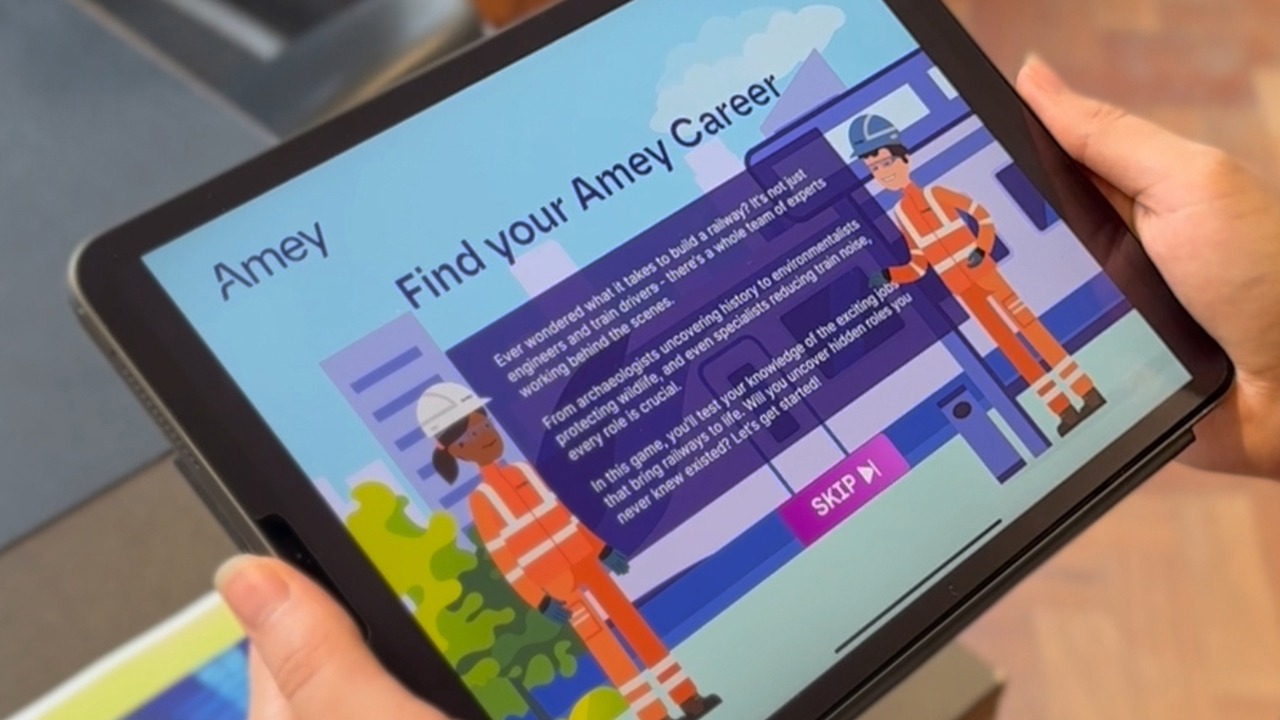
Photo of a person holding a tablet in landscape orientation showing the “Find your Amey Career” welcome screen, with a blurred desktop and event materials in the background - AR Development Agency elearning gamification
A elearning game screen showing two bins, down a graffiti alley, with a graphic in the top left showing a score and a lives left indicator in the middle of the screen
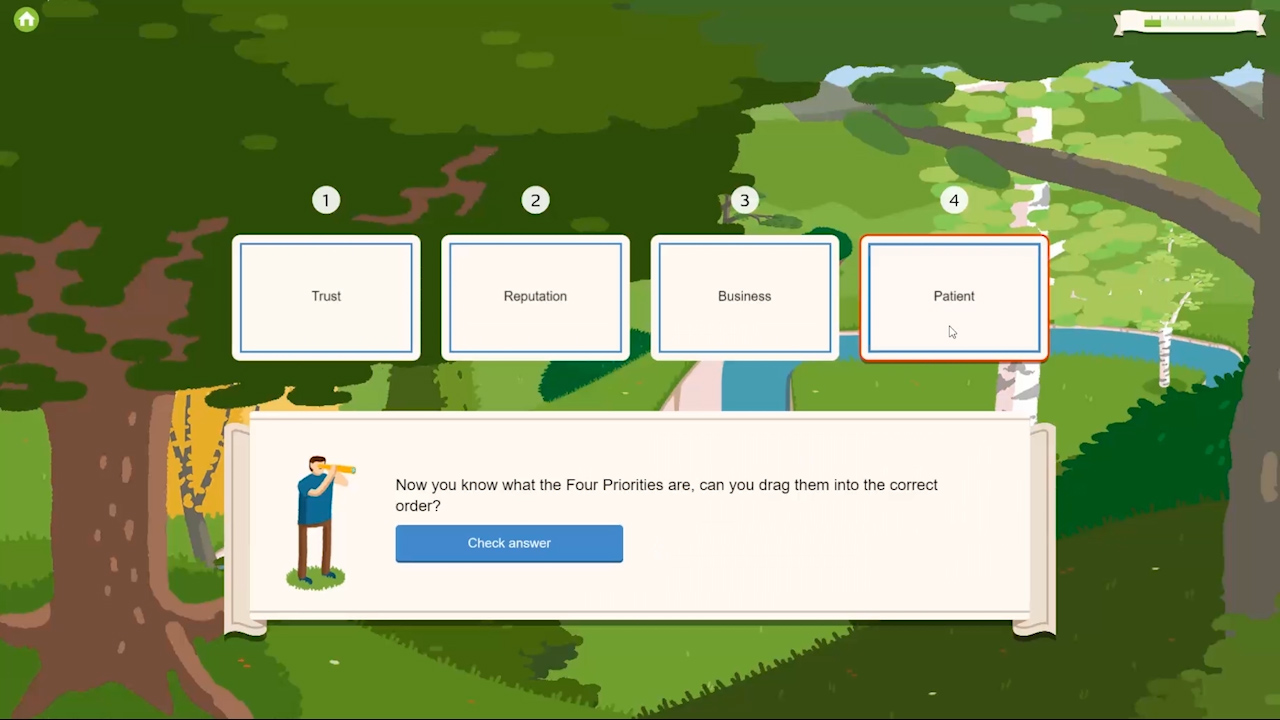
Elearning screen showing a drag-and-drop activity where users arrange four priorities—Trust, Reputation, Business, and Patient—into the correct order. The interface features illustrated forest scenery and a prompt with a “Check answer” button.