VR & AR Butchery Training For Hospitality

Thinking about VR Butchery? Probably not.

When you think about VR training, VR butchery probably doesn’t come to the top of your mind. Often we think about engineering, safety training or surgery – high-risk environments where mistakes in real life have or are dangerous.

However, there are huge benefits to understanding and learning about butchery that can support young people and entry into the hospitality industry.

Kitchens are increasingly bringing meat preparation back in-house. Plumpton College, which runs a Butchery Skills Bootcamp designed specifically for the hospitality sector, points to the rising cost and limitations of buying pre-prepared meat as a key reason why in-house butchery expertise is ‘more important than ever’. For a young person starting out in a kitchen, being able to work confidently with whole carcasses, reduce waste and get the most from every cut is a skill that helps them stand out.

Sliced Bread partnered with Vancouver Community College to create VR training for butchery techniques, which followed on from our AR Butchery application. These virtual learning experiences provide a safe, repeatable, and engaging environment. Using hand-tracking and realistic butchery simulations, learners can practice butchery skills, make mistakes, and learn faster without wasting proteins or risking injury.

Building butchery skills before the first real cut

Learning professional butchery is inherently hands-on. Students need to understand anatomy in three dimensions, learn where and how to cut, become familiar with specialist tools and develop the confidence to put that knowledge into practice.

But practising on real protein has a cost. Mistakes mean wasted product, and for inexperienced learners, the first cuts can be intimidating.

We created an immersive VR and AR butchery training experience that gives students the opportunity to learn, practise and repeat the process virtually before working with real protein.

The range of VR proteins we developed for this butchery experience include:

  • Beef
  • Pork
  • Lamb
  • Chicken
  • Halibut
  • Salmon

The experience combines:

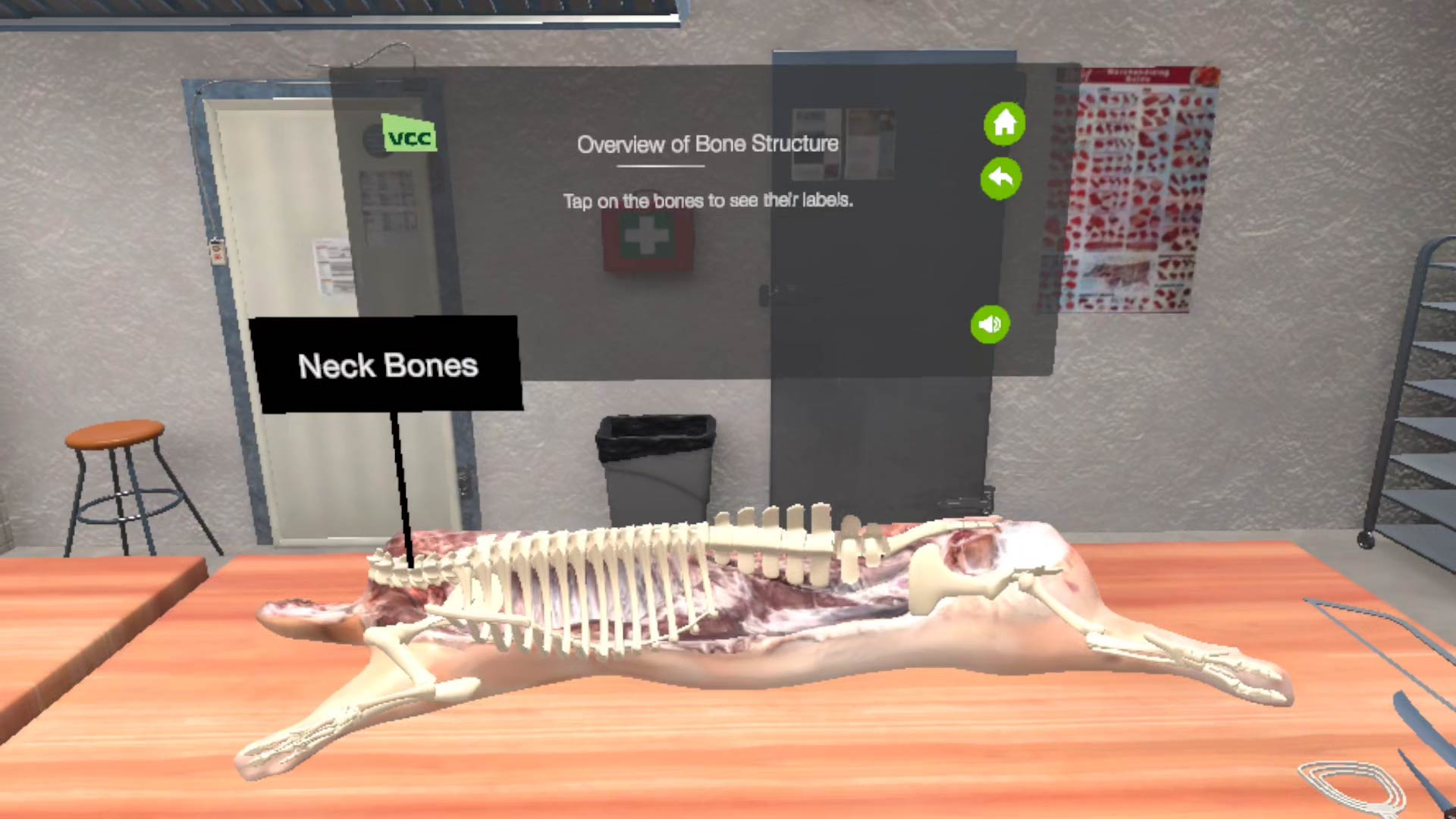
  • Detailed interactive 3D anatomy and butchery models
  • Step-by-step procedural guidance
  • Realistic tool interaction
  • Guided cutting paths and accuracy checking
  • Visual prompts and labels
  • Progressive stages that respond to learner actions
  • Secondary cuts overview
  • Cooking Methods overview for all secondary cuts
  • Quiz to check knowledge retention
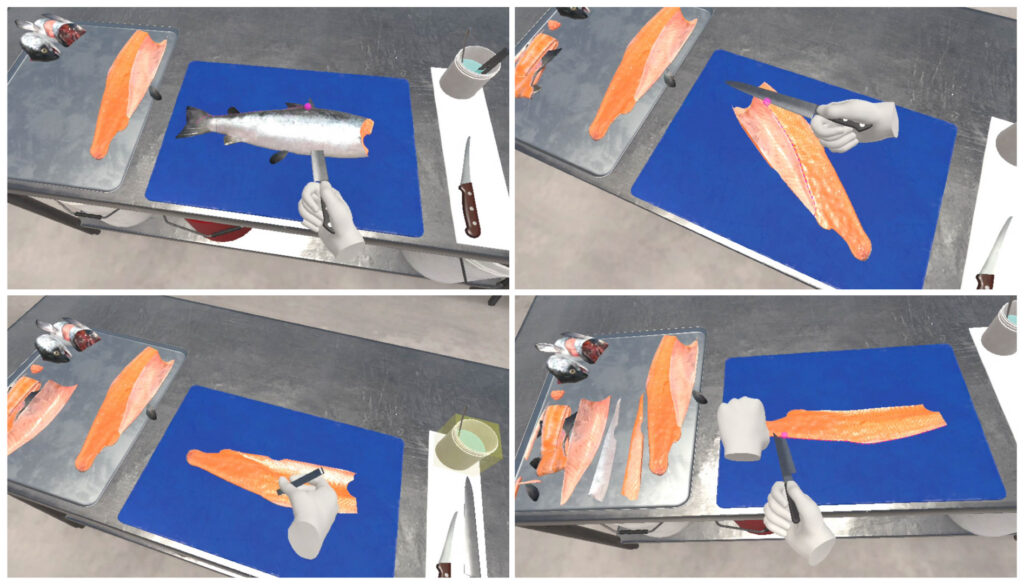
Four screenshots from a VR cooking simulation showing virtual hands using a knife to fillet and prepare salmon on a blue chopping board in a professional kitchen.

VR Butchery – Practice without waste

Traditional butchery training depends heavily on demonstrations, physical carcasses, specialist equipment and access to experienced trainers. This can make training expensive, difficult to repeat and hard to standardise across different learners and locations.

In VR, learners work through the butchery process step by step. They physically interact with the training content, selecting tools such as knives and saws and following defined cutting paths through each stage of the process. Each successful action progressively reveals the next stage of the task.

Cuts can be repeated as many times as needed without wasting protein.

This is particularly important when working with something like beef. A carcass is large, requires considerable space and is expensive, which means training providers may only be able to bring real examples into the classroom a limited number of times each year.

VR makes that learning experience available repeatedly, without requiring another carcass every time a student needs more practice.

Valuable real-world materials can then be reserved for the point at which learners are better prepared to use them — reducing waste while making hands-on training more effective.

A front-row view for every learner – as many times as they need it.

Practical demonstrations also have limitations.

A student may be absent on the day a particular butchery lesson takes place. Or they may be present, but standing behind a group of other students with only a partial view of the demonstration.

With a large piece of protein such as beef, there may simply not be enough physical space for every student to stand close enough to clearly understand each cut.

VR provides a valuable way to catch up, revisit and properly explore the lesson afterwards.

Instead of trying to remember a demonstration they saw once, learners can step inside a detailed simulation, move around the anatomy, examine it from different angles and work through the cuts themselves.

From Knowledge to Capability – From Understanding to Doing

Butchery isn’t something you learn simply by reading instructions or watching someone else do it. It is difficult to teach through traditional classroom materials alone.

Immersive learning puts the learner inside the task.

Students develop a spatial, 3D understanding of the anatomy: where structures sit in relation to one another, how a cut should travel through the carcass and how each stage connects to the next. By combining spatial learning, interaction and visual feedback, the experience helps bridge the gap between knowing the steps and understanding how to perform them.

Repeated interaction also helps learners become familiar with the movements, sequencing and tool handling involved. This embodied learning builds motor familiarity and confidence before those skills are transferred to real-world practice.

The aim isn’t to replace hands-on training. It’s to make that training count.

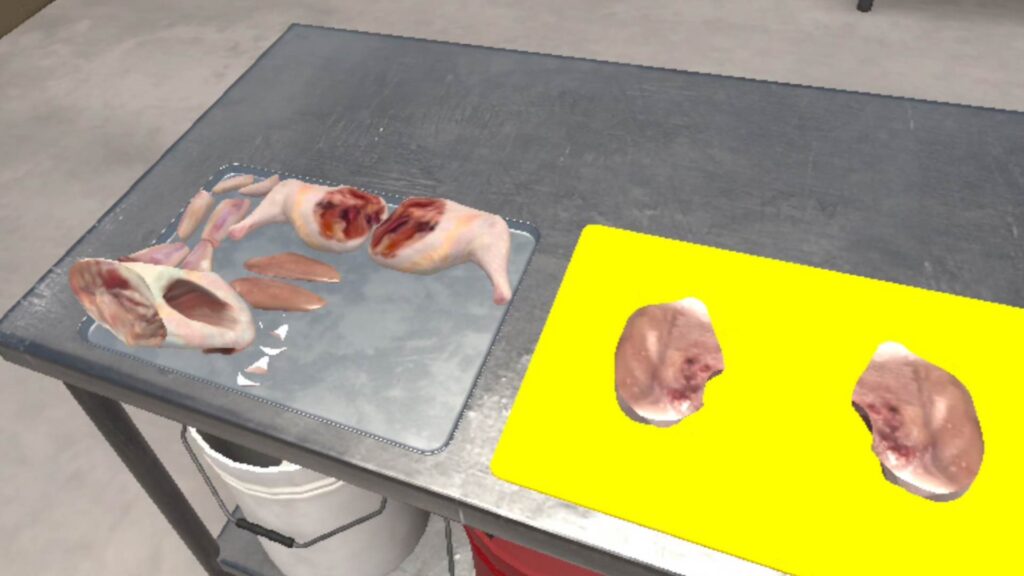
Screenshot from a VR butchery simulation showing raw chicken portions on a bright yellow chopping board, with additional chicken pieces arranged on a metal tray in a virtual professional kitchen.

A Safer Place to Learn

VR also offers a psychological advantage for beginners.

A virtual knife can’t cut the learner’s hand. A mistake doesn’t ruin an expensive piece of protein. And an incorrect cut can simply be tried again.

Just as importantly, learners can practise without somebody looking over their shoulder.

For some learners — including neurodiverse students who may find busy practical environments, observation or immediate social pressure challenging — this can provide a valuable alternative space in which to become familiar with a task at their own pace.

There is room to pause. To repeat. To make mistakes privately. And to build confidence before demonstrating the skill in front of others.

VR Butchery – Real-World Practice

By the time students move on to real-world practice, the process is no longer completely unfamiliar.

They’ve seen it. Explored it. Practice it. Made mistakes and tried again.

That is where immersive technology becomes more than a visualisation tool. It becomes a way to prime learners for real-world performance. It improves confidence, reduces waste and makes learning stick.

Contact Us About Your VR Training Project

Click here to see further examples of VR training. Sliced Bread can help enhance understanding, improve retention, and bridge knowledge gaps in audiences by translating complicated concepts into engaging VR training. Get in touch with us today and find out what Sliced Bread can do for your organisation.

We’re an award-winning creative technology studio, bringing together storytelling, AI and immersive experiences to help organisations communicate and learn.

Click here to request a quote

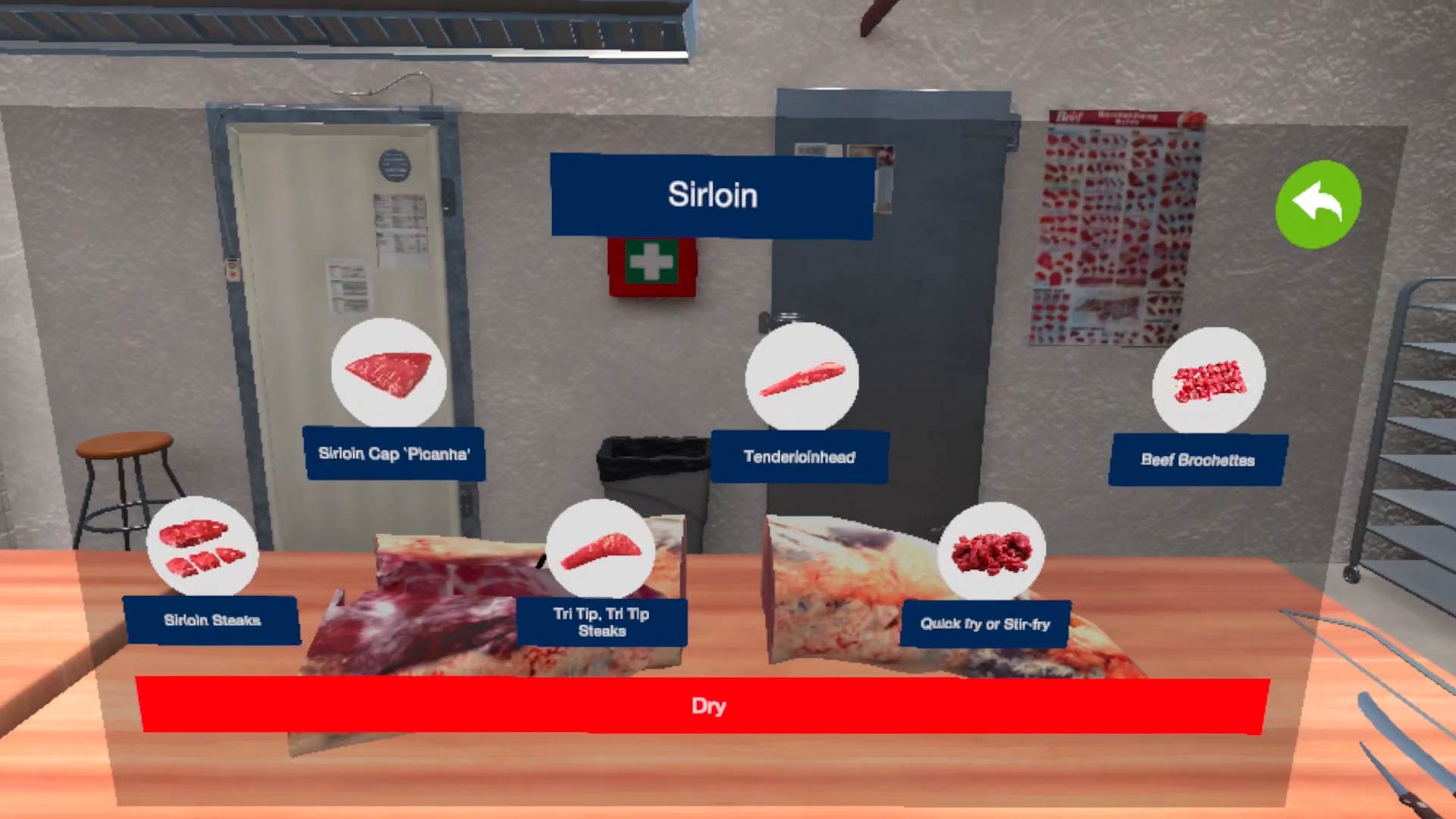
Screenshot from a VR butchery training simulation showing different sirloin beef cuts, including sirloin steaks, picanha, tri-tip, tenderloin, beef brochettes and stir-fry strips, displayed in a virtual butchery environment.